

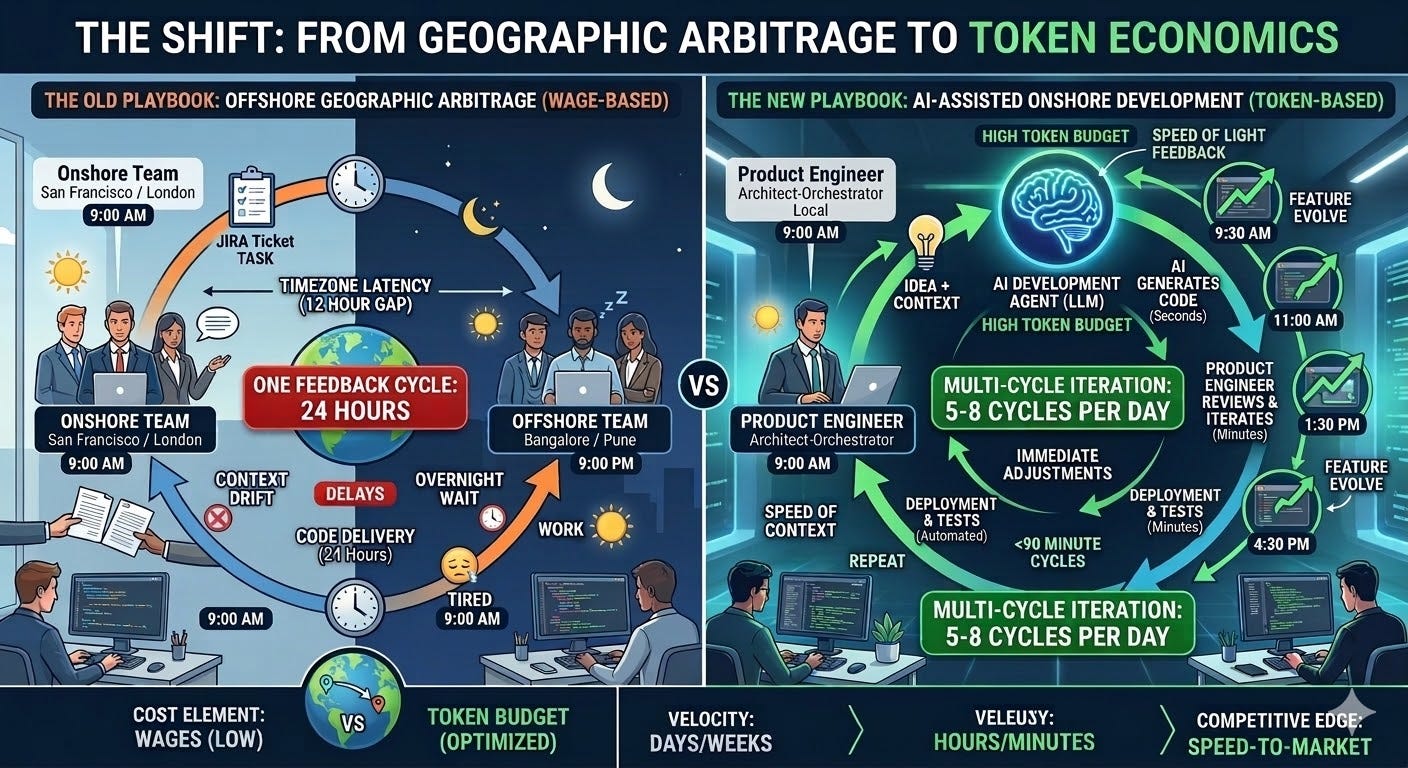
For thirty years, the standard playbook of lowering cost of software production was to move high cost software development from places like San Francisco, New York, London or Zurich, to low-cost locations like Pune, Bangalore or Manila.
We are now moving to a world where this will be akin to a corporate suicide note. The arithmetic is simple: the cost of producing software is falling close to zero.
In a world where the actual effort to write code is 10% of what it was a few years ago, how much are you really saving by having an engineer at half the salary on the other side of the planet, compared to how much you are losing in cycle-time due to timezones, and context by using a less skilled worker who doesn’t know your business?
The latency tax: the killer of time-to-market
AI allows us to build and move faster than ever before. This means we can reduce our cycle time for change and new features from days and weeks, to mere hours. An idea can be built, refined and demoed, multiple times in a single day.
In a vicious competitive landscape, who wins, the actor who can iterate and refine a value proposition 5-8x in a single day, or the actor who can do exactly one cycle every 24 hours, because timezone incompatibilities means they have a brief window of overlap once a day?
That cost-per-seat with your offshore provider will seem costlier than ever, when the competition is moving 5x faster. Even at half the salary, you are effectively paying 5x more for the same result per unit of time, all things being equal.
And all things are rarely equal, as we’ll soon discuss.
The context tax: the killer of quality
The second thing is, people working closely together, iterating on a problem, will always outperform disengaged people turning JIRA tickets they fully do not grasp the purpose of.
With increased speed of iteration, clarity of purpose becomes more important than ever - having a shared understanding of what you are trying to achieve, and more importantly why, will be competitive advantages.
Feeding people with ill-defined JIRA tickets, who then feed them onwards to AI assistants are going to combine the absolute worst aspects of offshore development with the worst aspects of generative AI: a drift between desired- and actual outcomes, and plenty of inferred bad assumptions and AI hallucinations to fill the gap.
Context + purpose eats cost savings and Taylorism for breakfast in the old world. AI grows it from a gap, to an ocean.
The Token Arbitrage
Historically, the unit of cost in software was the hour of human work. In the future, the unit of cost is the cost of tokens.
When a local/onshore engineer who truly understands the business they are working in, and the problem they are working on, is given a high token budget to use leading edge AI Assistants (such as Claude Code currently), combined with frontier models, working at a Level 7 of AI Assisted Software Engineering, they effectively become an industrial factory of automation and software creation.
The typical offshore firm’s model built on billable hours: they are incentivized to keep headcount high and processes manual. Conversely, a high-skill onshore lead aligned with the organization they are working in is incentivized to automate themselves out of everything mundane and repetitive.
The outcome is a $200,000/year engineer with a monthly $5,000 compute- and token budget can now outperform and run rings around a $1000,000/year managed offshore team. The premium paid for an “Architect-Orchestrator” isn’t an expense, it’s the most efficient CAPEX investment you can make.
Conclusion
The era of geographic labor arbitrage was built on a simple assumption: human labor was the scarcest resource in software. AI has completely up-ended this assumption - human labor is no longer the key input for ROI per unit of time.
The new math of software production looks like this:
Velocity + Context + Compute > Cheap Labor
If you continue to optimize for the lowest hourly rate, you are effectively choosing to pay a 400-500% tax, while reducing your chances of survival. You are choosing to be slower in a world that is moving faster. You are choosing to be “lost in translation” in a world where context is the only moat left.
The winners of the next decade won’t be companies that best optimize their blended cost of labor. The winners will be lean, high-context teams located in the same timezone, fueled by sufficient token budgets, turning ideas into reality and testing them on real customers before their offshore-reliant competitors have even finished their morning stand-up.
The map of the software world is being redrawn. The future belongs to the Product Engineer.